
Hair concerns
Thinning Hair (Men)
A receding hairline, crown thinning, or reduced density.
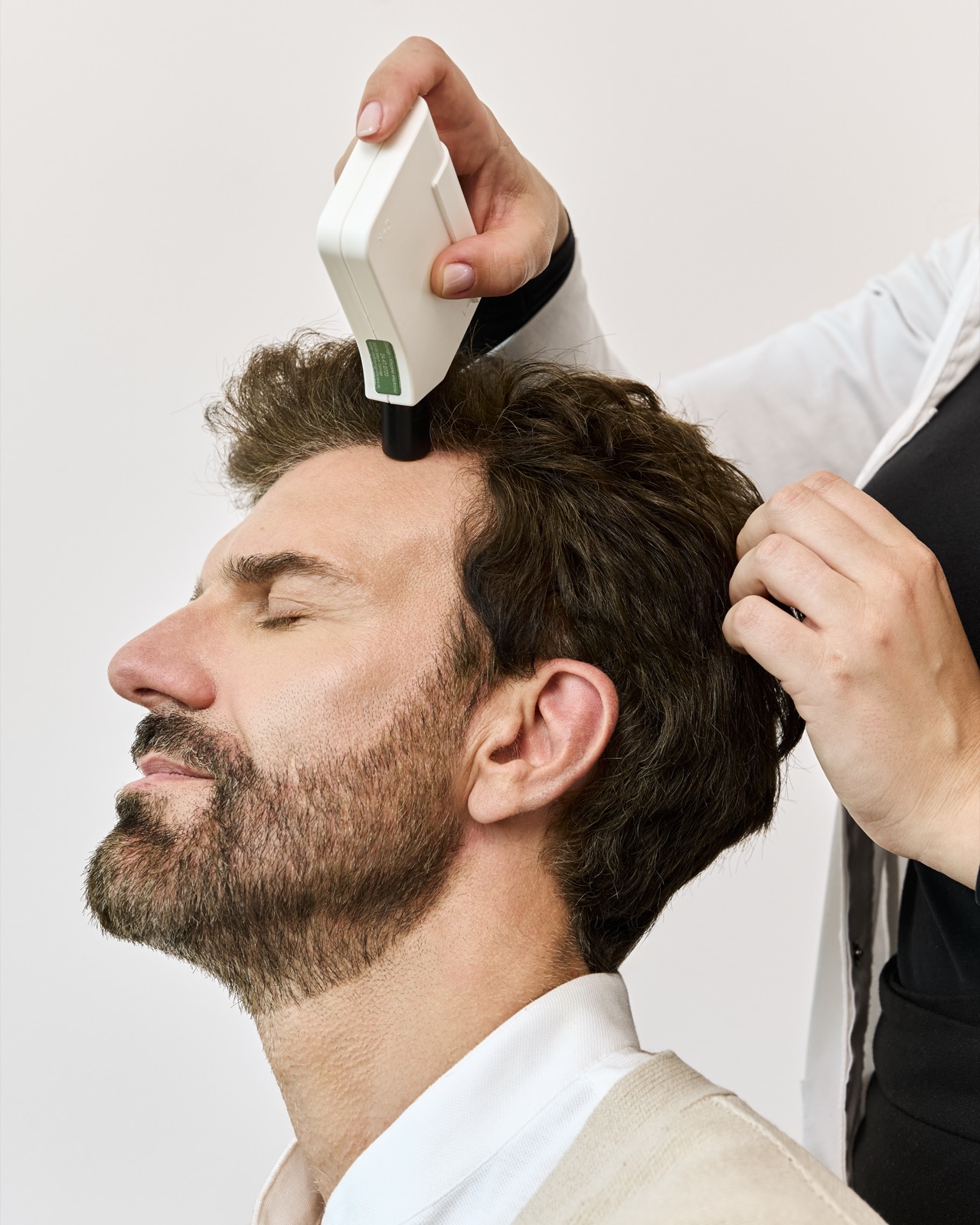
What you may notice
Signs to look for.
- The hairline moving back at the temples
- A thinner patch at the crown, most visible in photos or under bright light
- Hair that looks finer and shorter than it used to
- Styling that no longer hides the scalp the way it did
What may be behind it
Multiple factors can contribute.
- Genetics
- Male pattern hair loss is strongly hereditary and can begin as early as the late teens or twenties.
- Hormones
- Follicles that are genetically sensitive to DHT, a by-product of testosterone, gradually become finer.
- Typical pattern
- A receding hairline at the temples and thinning at the crown, which may progress over time.
These are general patterns — your own assessment is what matters.
How we assess it
A scientific, personalized evaluation.
Advanced imaging, clinical expertise and a detailed consultation help us understand what is contributing to your hair loss.
Our 4-step method
Detailed consultation
Your history, lifestyle and goals.
Scalp imaging
TricoTest® microcamera imaging of your hair and scalp.
Findings review
What may be contributing to your hair changes.
Personalized plan
A plan designed around you, reviewed over time.
Recommended care
Personalized solutions for healthier, fuller-looking hair.
Hair & Scalp Analysis
Advanced imaging and expert evaluation to understand what is behind your hair loss.
Learn moreFor advanced hair loss: CNC®
A custom, non-surgical cranial prosthesis, individually made in Italy.
Learn moreFrequently asked questions
Your questions, answered.
We do not diagnose medical conditions; when medical care is involved, we collaborate with your physician.
Is hair loss different for women and men?
Often, yes — in the hormones involved and in how it typically appears. The assessment is the same for everyone: we look closely at your own history, hair and scalp.
What is the most common cause of hair loss?
Pattern hair loss — female or male — is among the most common causes, but hormonal changes, stress, medical conditions, nutrition and hair care practices can also play a role. Often it is a combination, which is why a personal assessment matters.
Can hair loss be reversed?
It depends on the cause. Some shedding improves once the trigger is addressed, while other types are progressive and benefit from early, consistent care. Results vary, and your specialist will discuss realistic expectations.
How do you identify the cause of my hair loss?
Through a detailed consultation and a TricoTest® analysis with microcamera imaging. We do not diagnose medical conditions; when medical care is involved, we collaborate with your physician.
Still have a question?
Call us, or book a private consultation and ask in person.
Your next step
Start by understanding your scalp.
A private consultation in Laguna Hills.
- Hours
- Tuesday – Saturday · 9 AM – 5 PM
By appointment only - Private & no obligation
- Consultations take place one-to-one, in a private room.